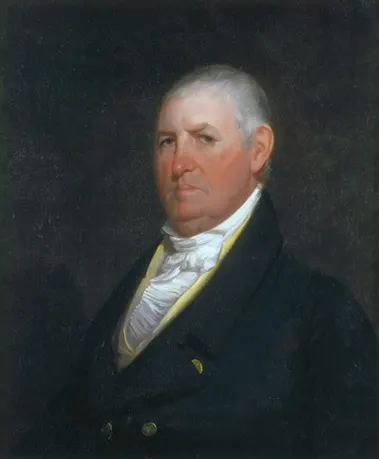
Isaac Shelby (December 11, 1750 – July 18, 1826) was an American politician and military officer who was the first and fifth governor of Kentucky and served in the state legislatures of Virginia and North Carolina. He also fought in Lord Dunmore's War, the American Revolutionary War, and the War of 1812. While governor, he led the Kentucky militia in the Battle of the Thames, an action that was rewarded with a Congressional Gold Medal.
Counties in nine states, and several cities and military bases, have been named in his honor. His fondness for John Dickinson's "The Liberty Song" is believed to be the reason Kentucky adopted the state motto "United we stand, divided we fall". Shelby's military service began when he served as second-in-command to his father at the Battle of Point Pleasant, the only major battle of Lord Dunmore's War.
He gained the reputation of an expert woodsman and surveyor and spent the early part of the Revolutionary War gathering supplies for the Continental Army. Later in the war, he and John Sevier led expeditions over the Appalachian Mountains against British forces in North Carolina. He played a pivotal role in the American victory at the Battle of Kings Mountain.
For his service, Shelby was presented with a ceremonial sword and a pair of pistols by the North Carolina legislature, and the nickname "Old Kings Mountain" followed him the rest of his life. Following the war, Shelby relocated to Kentucky on lands awarded to him for his military service and became involved in Kentucky's transition from a county of Virginia to a separate state.